Works by successful comic writers are often collected and published in book form. This doesn’t make them novels, so even when they lack words, they are not wordless novels.
There is no consensus among theorists and historians on a definition of comics.
as per Wikipedia entry for Comics
There are numerous examples of these collections with the following being an arbitrary list by German, American, and Danish writers:
Vater und Sohn (Father and Son)
Erich Ohser, under the pen name e.o. plauen, created Vater und Sohn, a gag strip that ran for 157 weekly issues in Berliner lllustrirte Zeitung starting in 1934. David Beronä in his book, Wordless Books, The Original Graphic Novels (2008) characterized the strip as part of the wordless novel genre. We disagree and list it under Dead-end. Each page is a stand-alone entry and as a whole they do not amount to a narrative.
The bulk of the strips were published in three booklets, which were released in numerous editions:
- Erich Ohser: Vater und Sohn: 50 lustige Streiche und Abenteuer, Ullstein Verlag, Berlin 1935
- Erich Ohser: Vater und Sohn: 50 neue lustige Streiche und Abenteuer, Ullstein Verlag, Berlin 1936
- Erich Ohser: Vater und Sohn: Noch 50 lustige Streiche und Abenteuer, Ullstein Verlag, Berlin 1938
Little Lulu
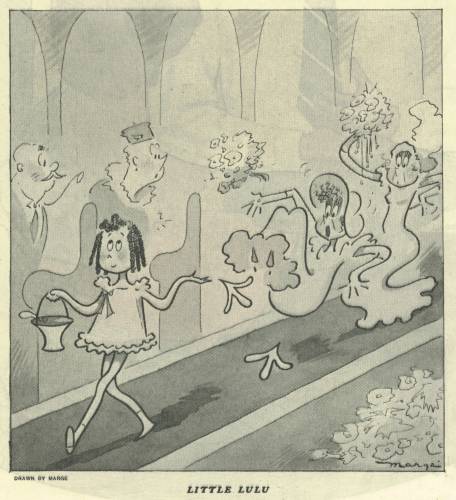
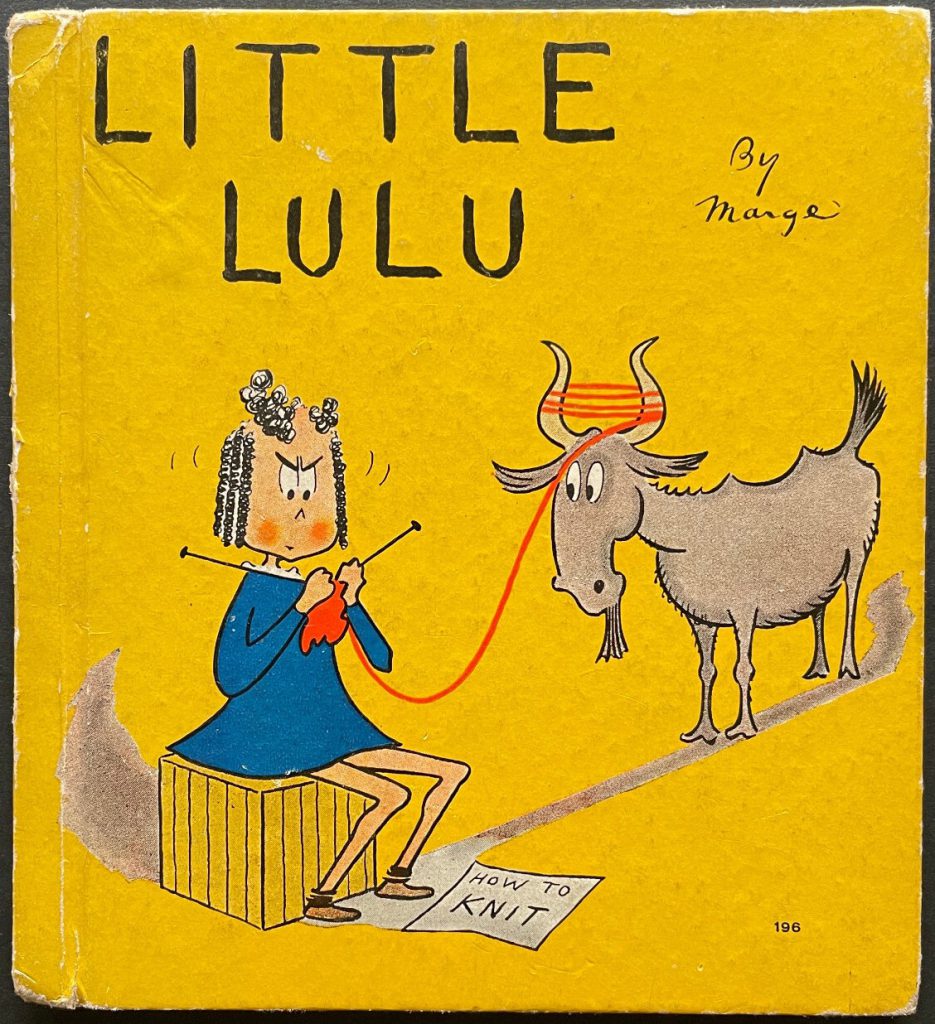
Little Lulu was created in 1935 by American author Marjorie Henderson Buell and debuted in The Saturday Evening Post on February 23, 1935, in a single panel, as a flower girl at a wedding who mischievously strews the aisle with banana peels. The panel continued to run weekly until December 30, 1944, as per Wikipedia.
Henry
Henry was a comic strip created in 1932 by Carl Thomas Anderson (1865 – 1948). The title character is a young bald boy who is mostly mute in the comics (and sometimes drawn without a mouth). After 84 years of syndication, Henry was discontinued on October 28, 2018.
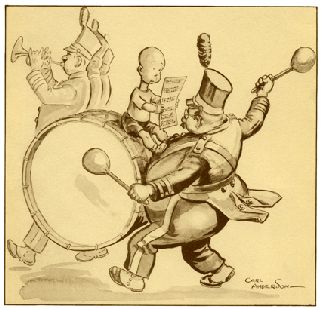
image credit: Wikipedia
Ferd’nand
Ferd’nand is a Danish pantomime comic notable for lacking word balloons and captions. Henning Dahl Mikkelsen created it, and it was first published in 1937. New strips continued until the third cartoonist to draw it left the strip in 2006. (as per Wikipedia). Since Ferd’nand is a pantomime, translation is not a problem, and the strip has been published in 30 countries.