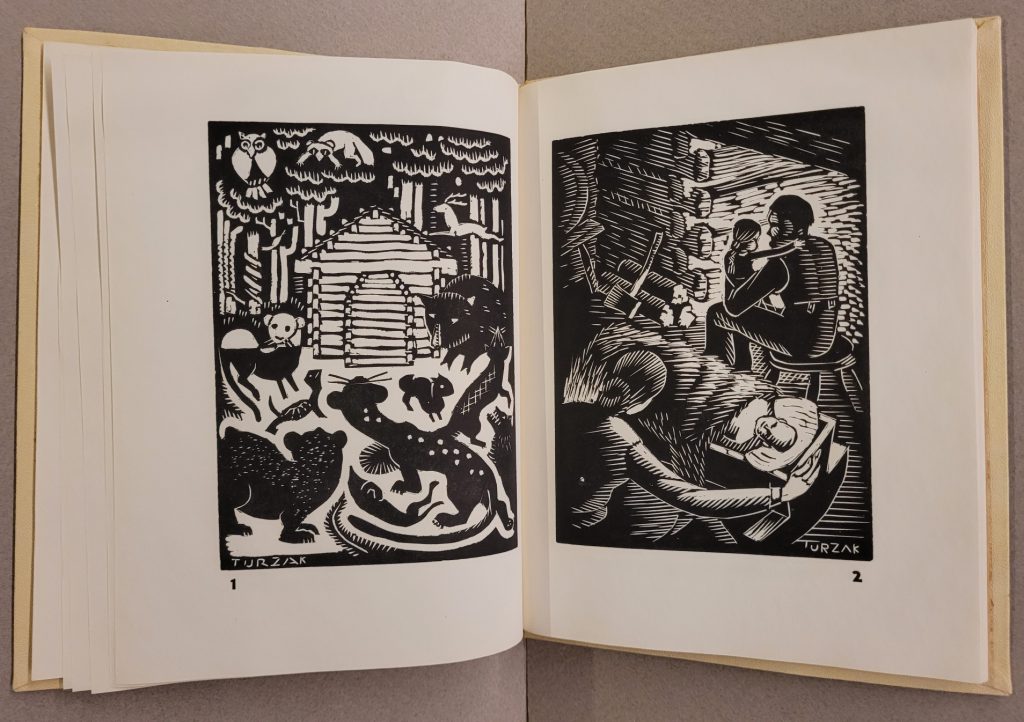
Irony – The Chicago Fair of 1933 celebrating a Century of Progress had Charles Turzak on site, cutting woodcuts for his wordless publication, Abraham Lincoln, using a 500-year-old printing method.
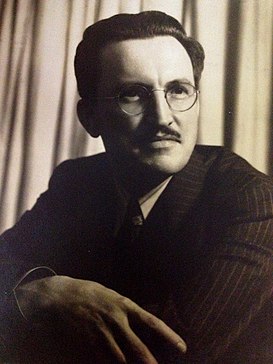
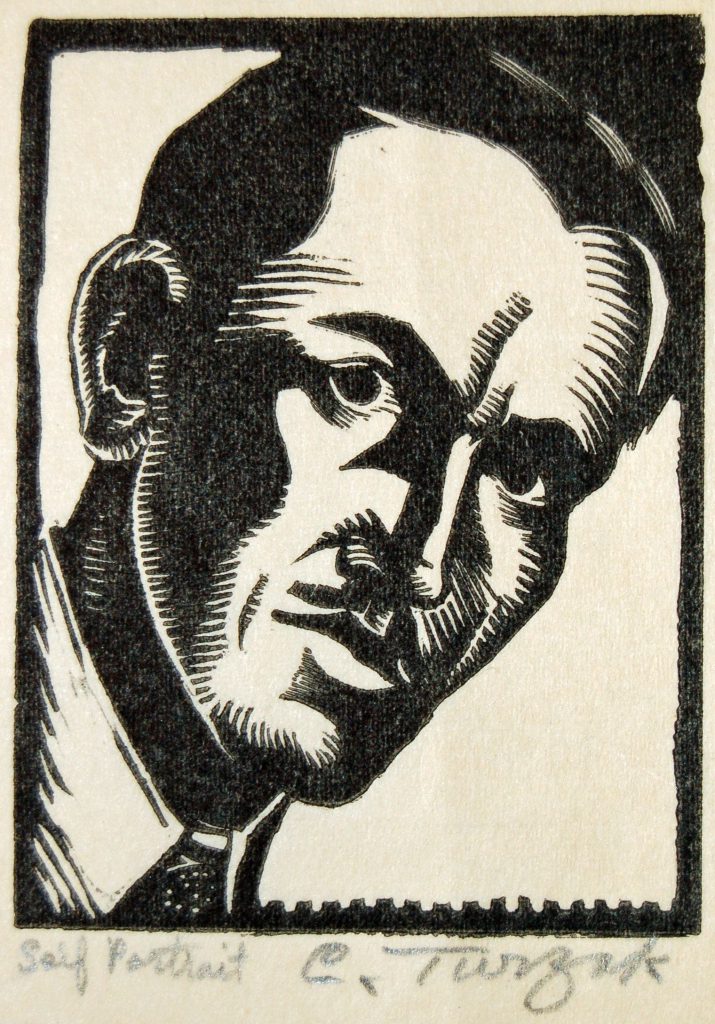
Charles Turzak b. 1899, Streator, IL – d. 1986, Orlando, FL.
I agree with David Beronä, in the Author’s Note to his book, Wordless Books: The Original Graphic Novels, referred to Turzak’s Abraham Lincoln: A Biography in Woodcuts as an anomaly, and I have listed it under the “Not-Quite” tab. It is a collection of images showing selected highlights of Lincoln’s life. An outsider with no knowledge of American history would not be able to “read” the book or recount any story.
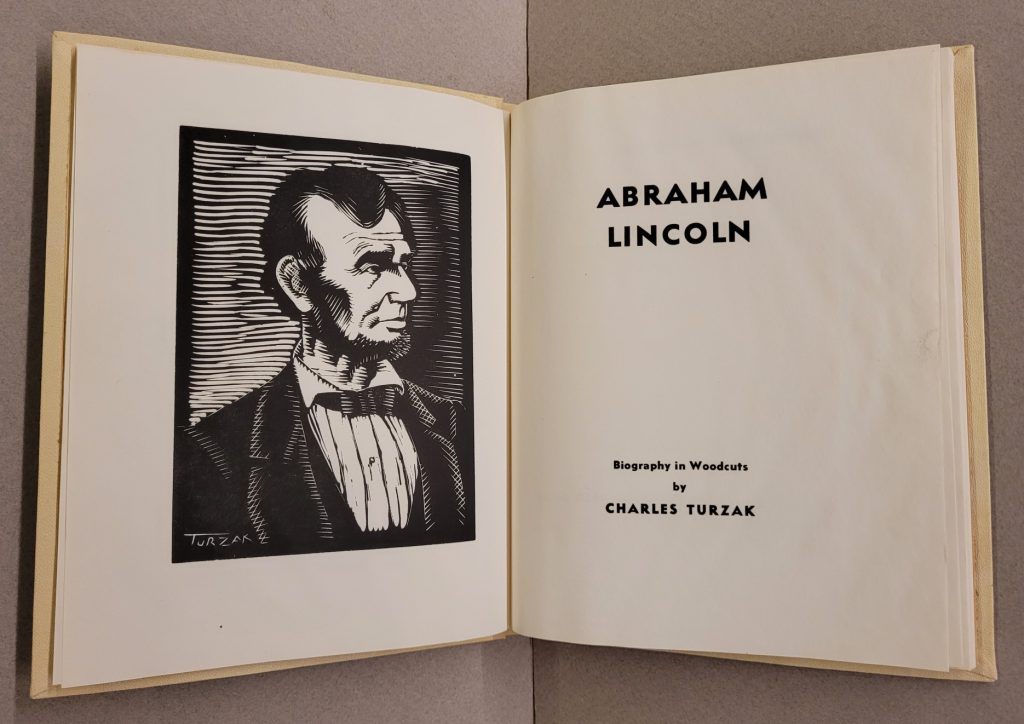
Abraham Lincoln: A Biography in Woodcuts 1933
Turzak completed this book during the 1933 Chicago World’s Fair (Century of Progress exhibition) in Lincoln Village. He occupied a space representing a small town store and cut the blocks where passersby could watch him. Beronä noted the irony that Turzak was at an exhibition highlighting technological advances, yet he was using a printing process that had not changed significantly in the last 500 years.
Turzak claimed that his was the first ever wordless biography of any historical figure.
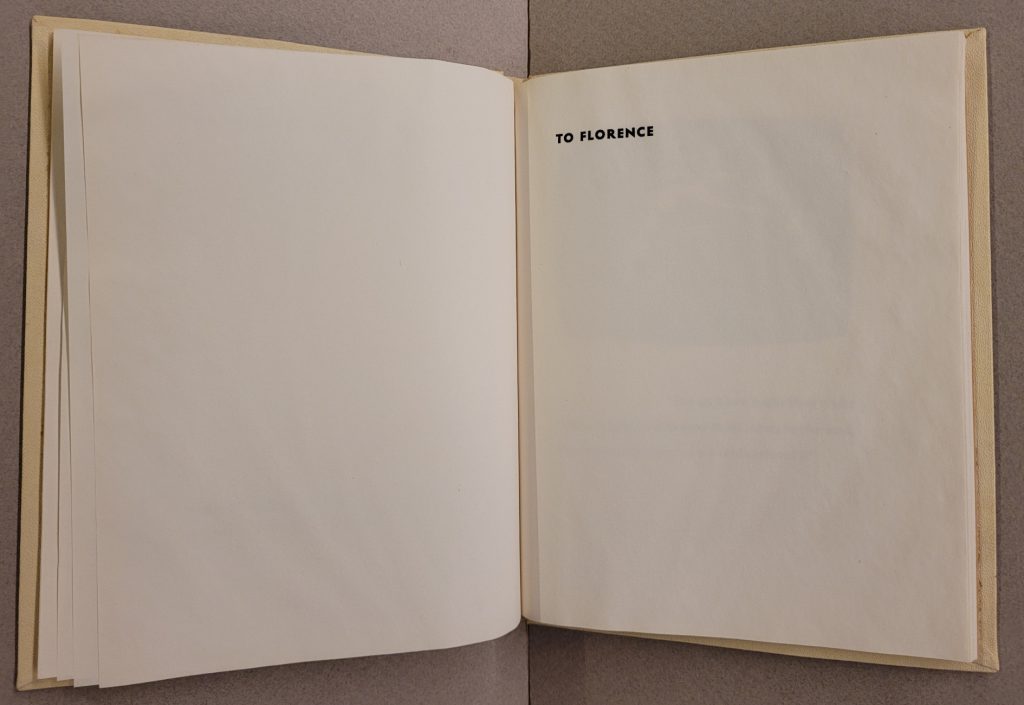
In 1931, Turzak married Florence Cockerham (1902–1999). He borrowed $50 from her wedding gift to pay for the high-quality paper on which he printed the Lincoln biography (as stated in “Carving Out Fame: Miner’s Son Abandons Coal to Work with Hands at Art,” Literary Digest, June 27, 1936, 22)
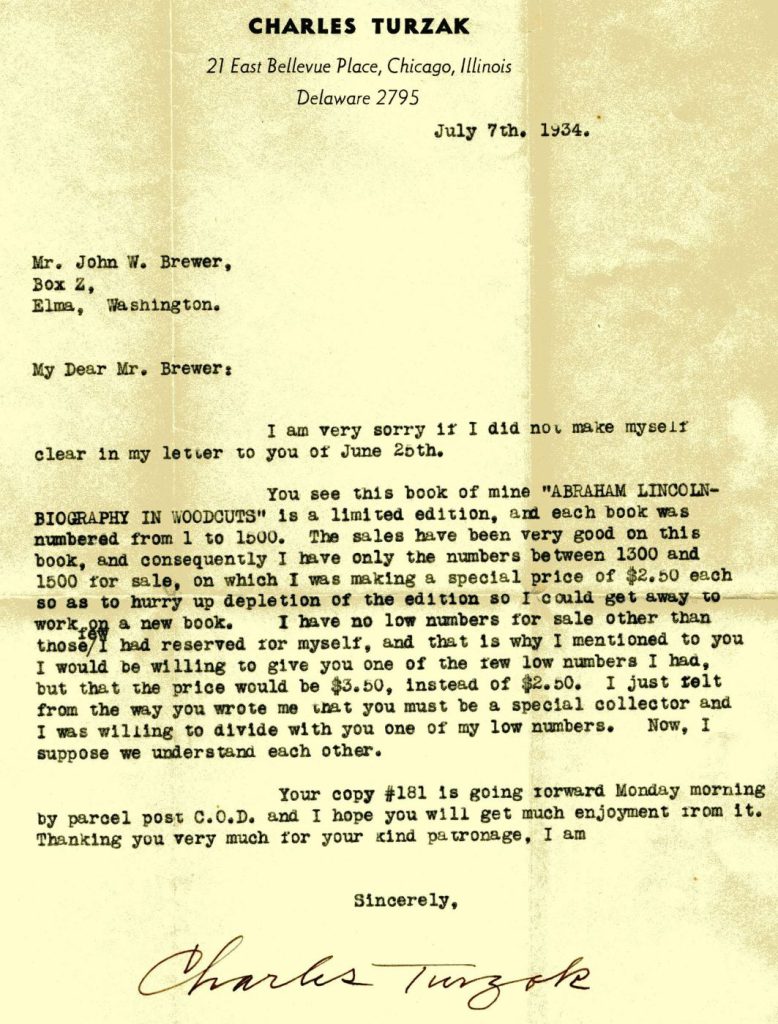
Turzak appears to have reduced it to $2.50 at some point.
This was at a time when a gallon of gas cost about a nickel.
Prospectus
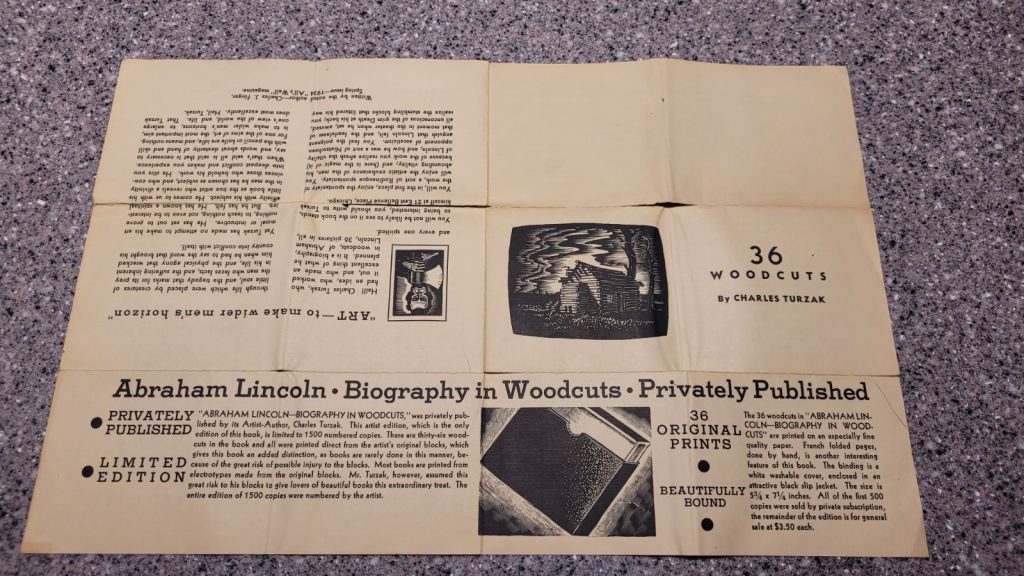
The prospectus makes it clear that the author printed the book directly from the woodblocks he cut and that each copy was numbered – there is no suggestion that copies were also to be signed, but many were.
Slipcase/Mailing Box/Dustcover
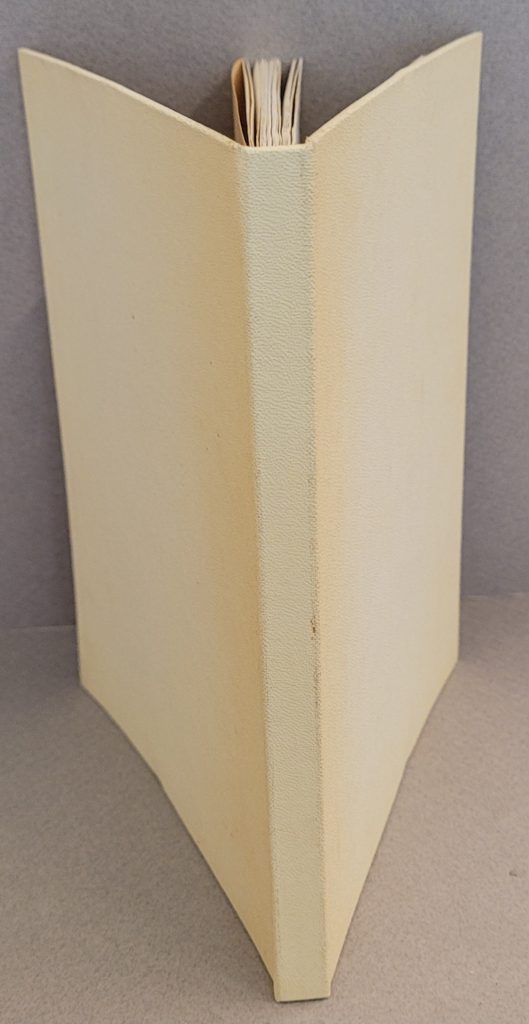
Slipcase – Apparently, the prospectus states the book comes with a black slipcase. Several copies have been sold with the slipcase (usually, the slipcase is pencil-numbered to correspond to the book’s limitation number). I don’t think any copies of the slipcase had images pasted on them.
Mailing box – Some copies were mailed out to buyers in a mailing box with a small print of Lincoln pasted to the front (see below). There is no room in the box to accommodate a slipcase.
Dustcover – Mark B. Pohlad in his excellent article, Charles Turzak’s Abraham Lincoln: Biography in Woodcuts (1933), J. of the Abraham Lincoln Assoc. Vol 34, Issue 2 Spring 2013, pp. 1-20. refers to figure 7, Deliberation (this is #30 in Turzak’s list), where Lincoln clasps his left wrist as the image “used for the original dustcover for Turzak’s book”.
- I have not seen a reference to any dustcovers; I assume dustcover is the same as dust jacket. If anyone has images of a dustcover, please send them to wn@wordlessnovels.com; photo credit will be given.
- I am not aware of any copies that have both a slipcase and a mailing box. I think it is either/or.
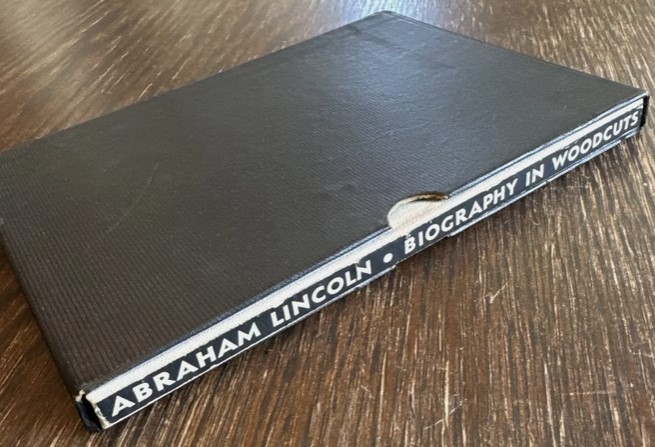
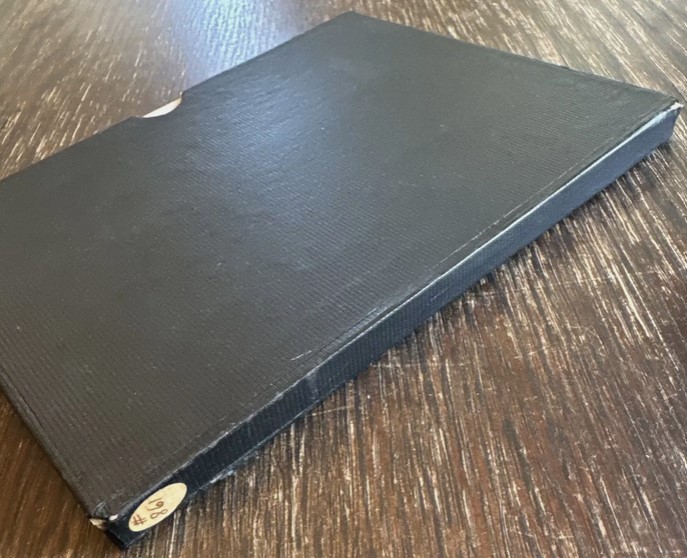
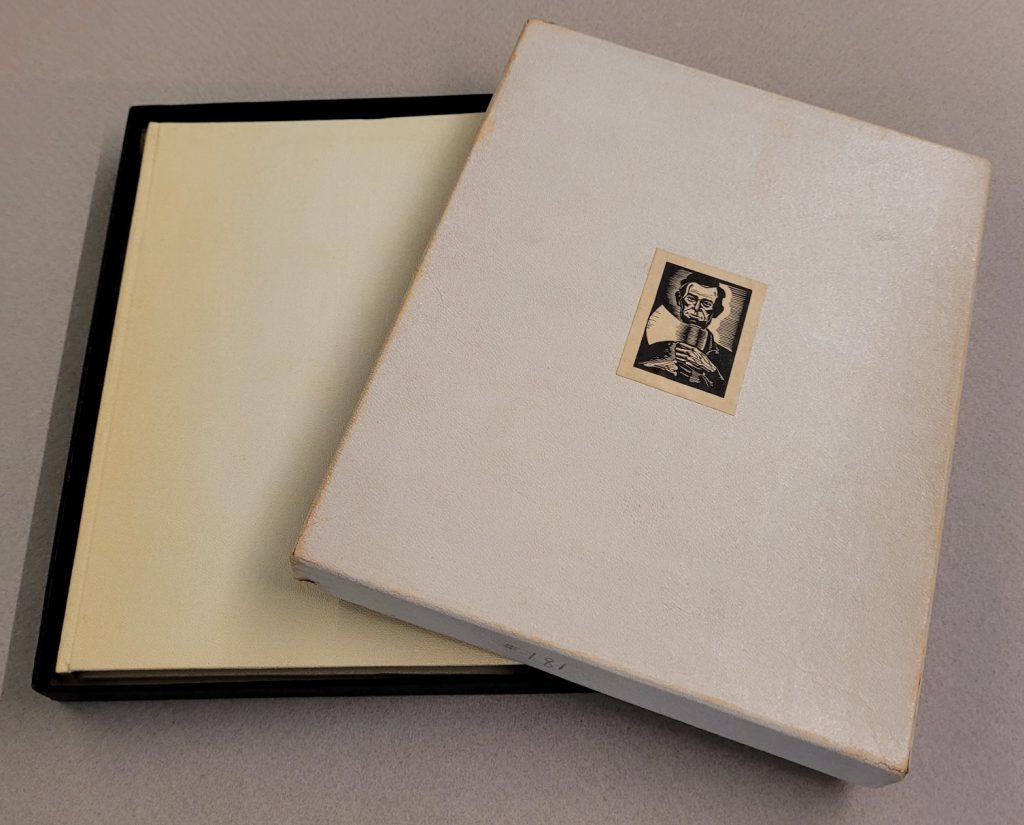
NOTE: This image of Lincoln holding the axe was not used in the book.
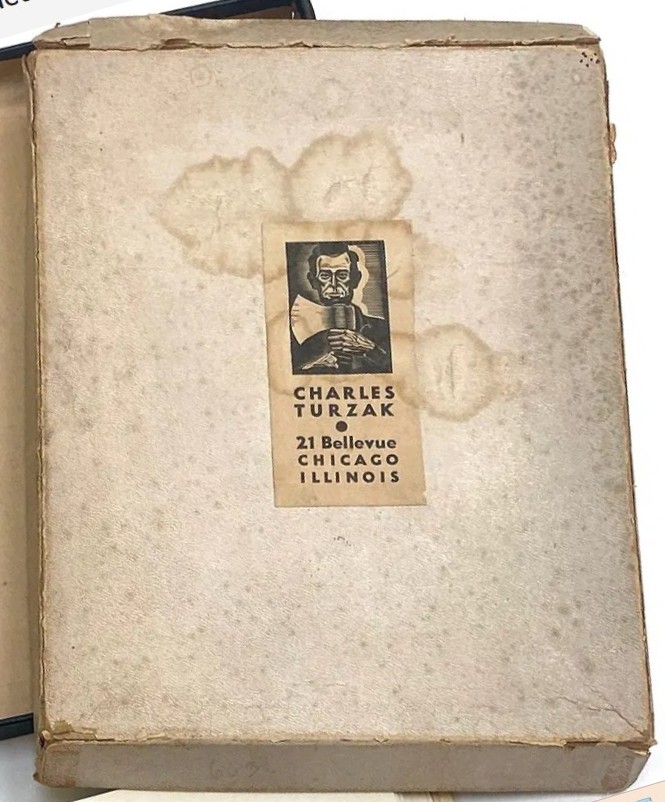
home address added. Image credit: J G Autographs
Problems with the production of the book
- Material used for the cover of the book:
- The prospectus suggests that the cover is washable (perhaps a nod to the “Century of Progress” exhibition).
- The cover material has a white, pebbly, shiny surface. I think it probably is washable – not that I have had a lot of need to wash books.
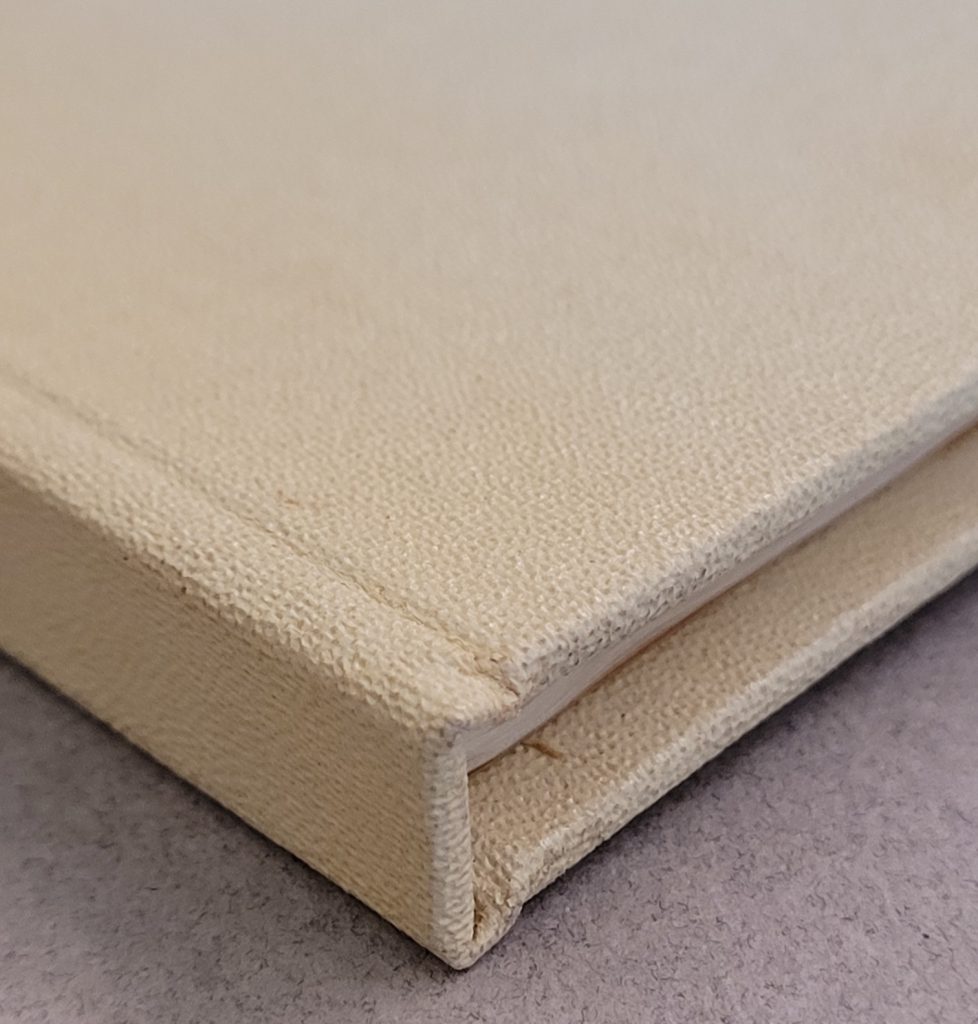
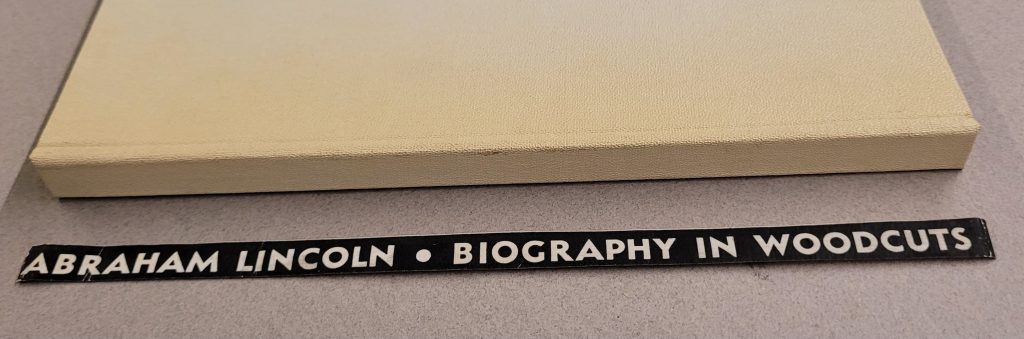
- THE PROBLEM – glue has trouble sticking to the shiny pebbly surface. A number of books have loose spine labels or portions of the spine label have broken off as in below:


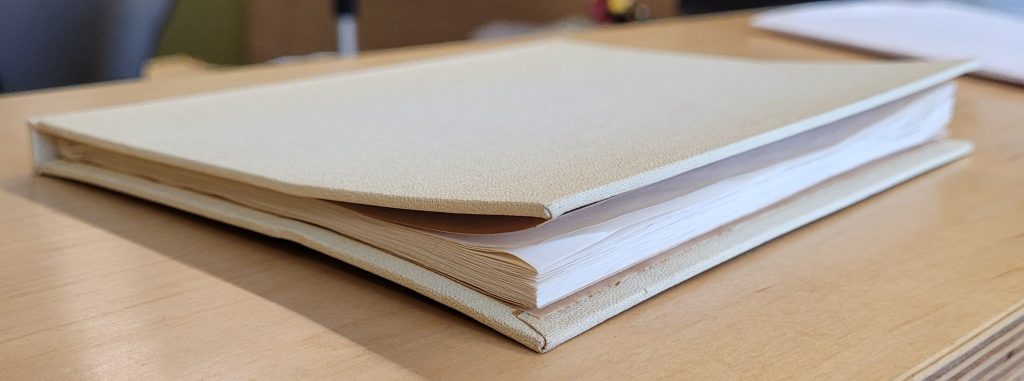
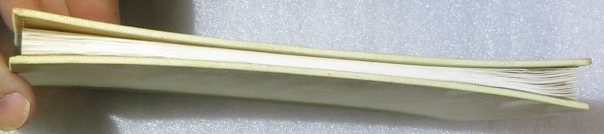
- Covers that are bowed/splayed/yapping
- Tension between different materials on a cover can cause it to bend.
- I suspect the shiny white material has created a problem for many of the copies. I believe the white material has contracted over time, or conversely, the white material is stable, but the paper card that it covers has swollen – in either case, causing the covers to bend.
Original Woodcut??
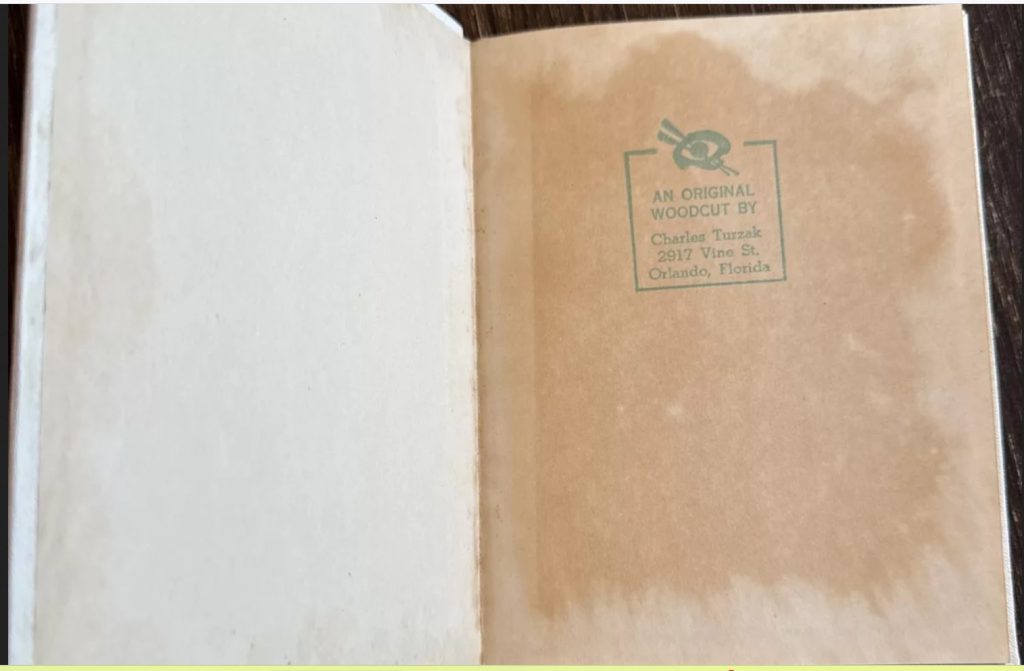
The printed words”An Original Woodcut by…” appear to be on the FFEP; confirmation would be appreciated. I have not seen this printed page (or is it just a rubber stamp on the FFEP?) in other copies.
-Did some copies come with an additional woodcut? What else could this wording mean?
NOTE: Based on the stamp’s address, this must be from 1958 or later, as Turzak lived in Chicago until 1958, when he moved to Orlando, Florida.
Book Details
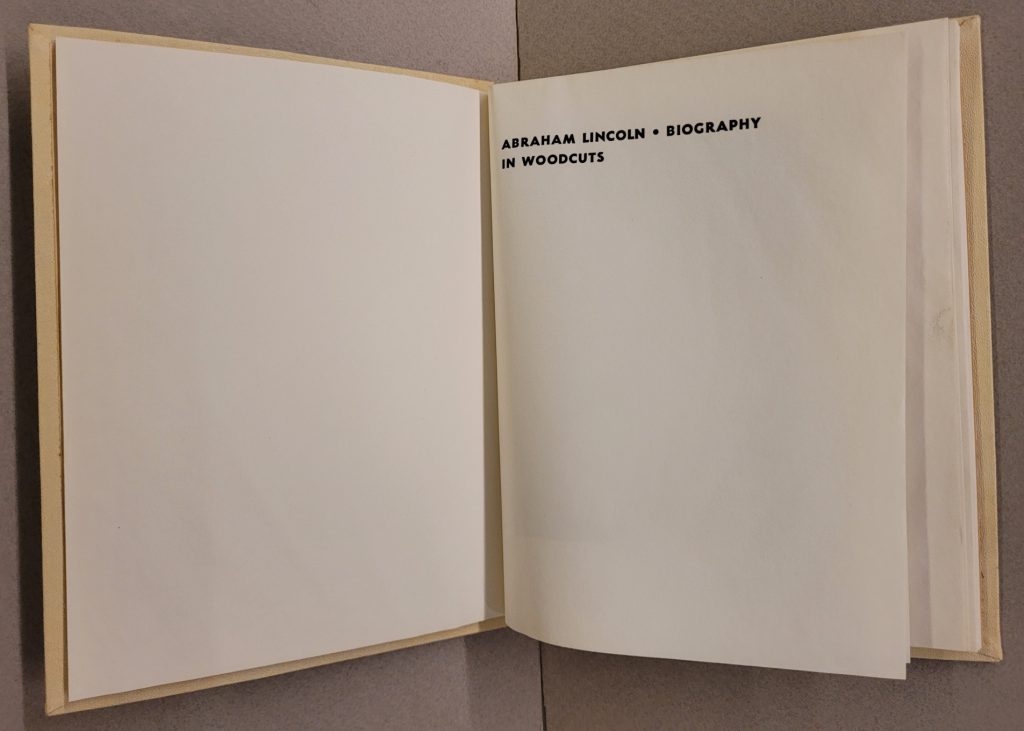
- Title: Abraham Lincoln: A Biography in Woodcuts
- A slim volume with 36 woodcuts on French folded bible stock bound and hand stitched
- Author and Illustrator: Charles Turzak
- Introduction: Turzak uses a quote, being the last sentence of Lincoln’s, Cooper Union Address; New York, February 27, 1860
- Date of publication: 1933
- Publisher: self-published?
- Place of publication: Chicago
- Printer: George C. Domke
- Typography: arranged by R. Hunter Middleton
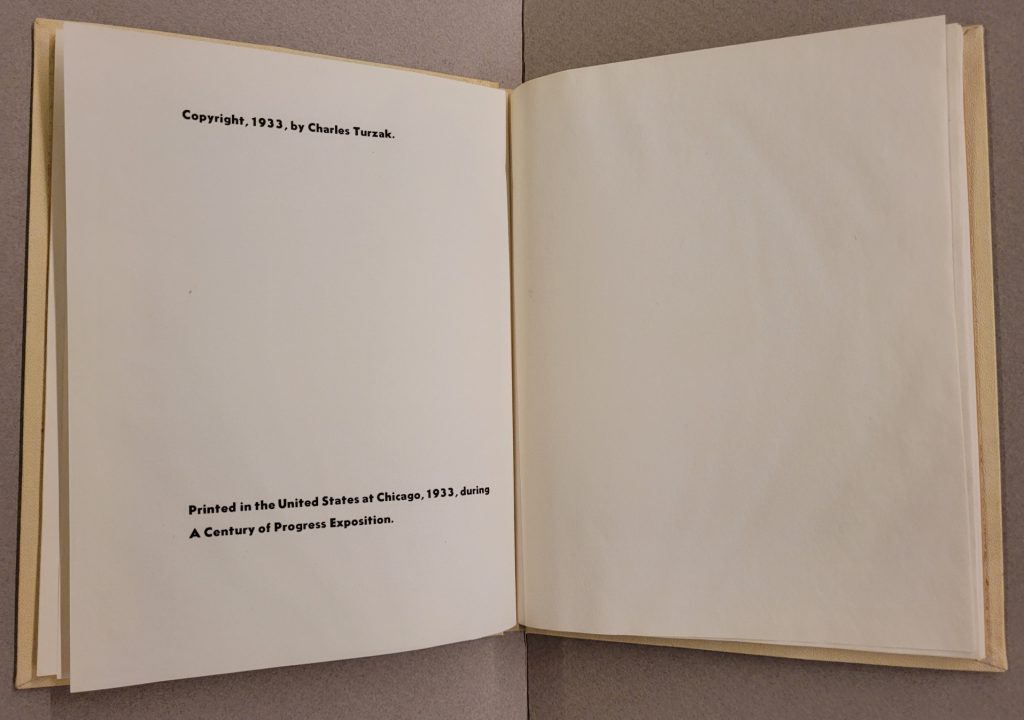
- Copyright: Artist
- Dimensions:
- Book: 18.5 × 14.4 × 0.8 cm (7 5/16 × 5 11/16 × 3/8 in.)
- Leafs: 17.8 × 12.8 cm (7 1/16 × 5 1/16 in.)
- Mailing box: 19.2 × 14.5 × 1.2 cm (7 9/16 × 5 3/4 × 1/2 in.)
- slipcase or a mailing box
- Binding: hard cover
- Cover: shiny, white, pebbled surface
- Language: English titles, etc
- Paginated: Sort of – the woodcuts are numbered 1 to 34, with two unnumbered prints (frontispiece and Log Cabin introduction) plus a quote from Stanton.
- Printed: verso and recto
- Edition: limited to 1500 copies
- Printed from the original wood blocks.
- Description: pages are a French fold
- 13 unnumbered pages,
- 34 pages of plates, numbered
- 9 unnumbered pages:
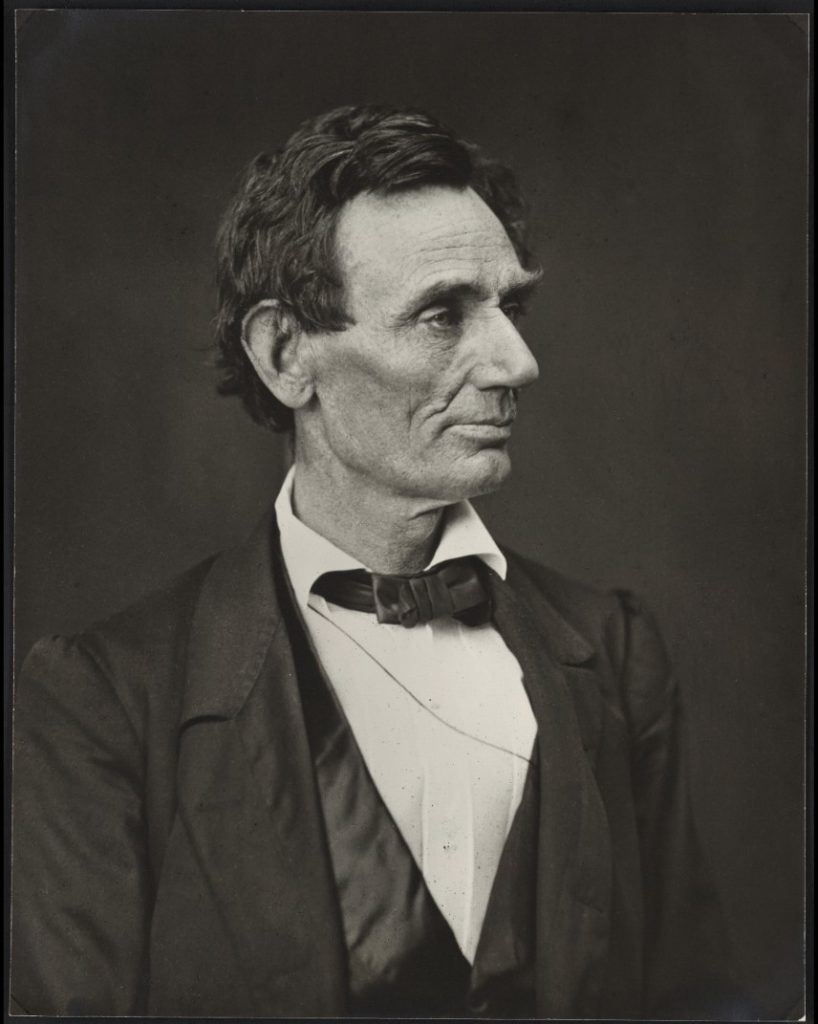
It is suggested Turzak used this photo as a model
and added a beard for the frontis.
Photo credit: Library of Congress, Rare Book
and Special Collections Division.
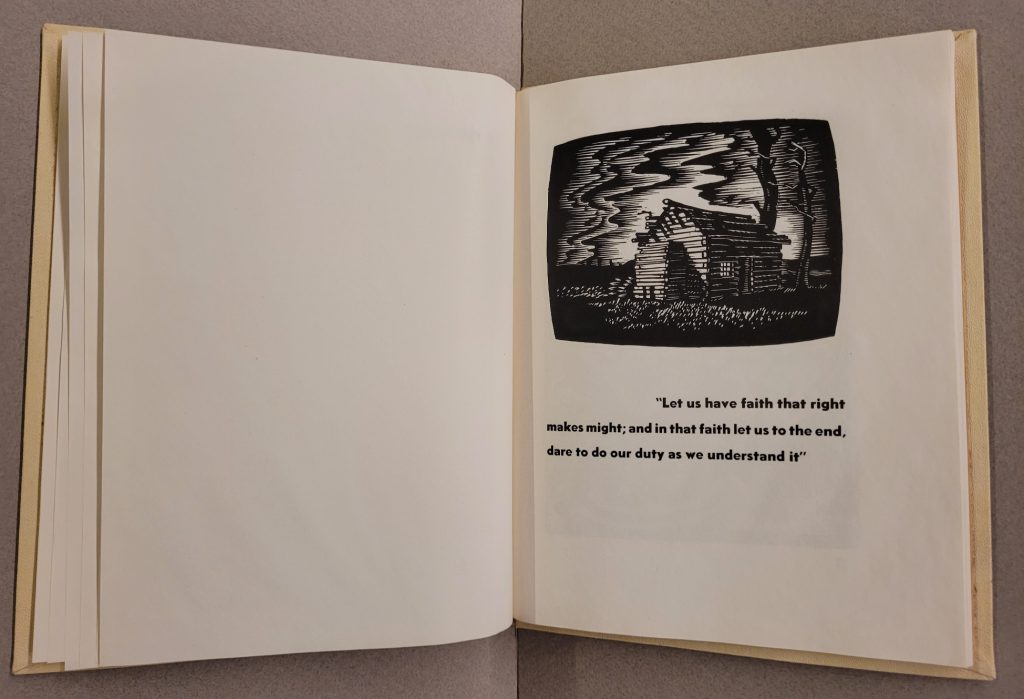
last sentence of Lincoln’s Cooper Union Address
New York, February 27, 1860
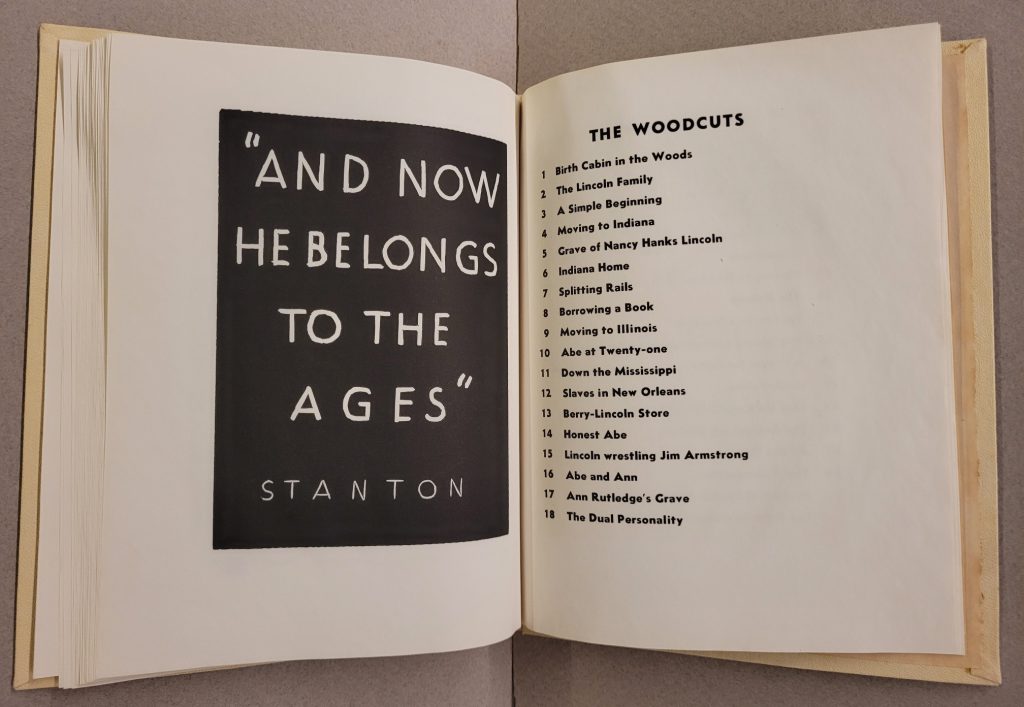
(assuming this was done as a woodcut).
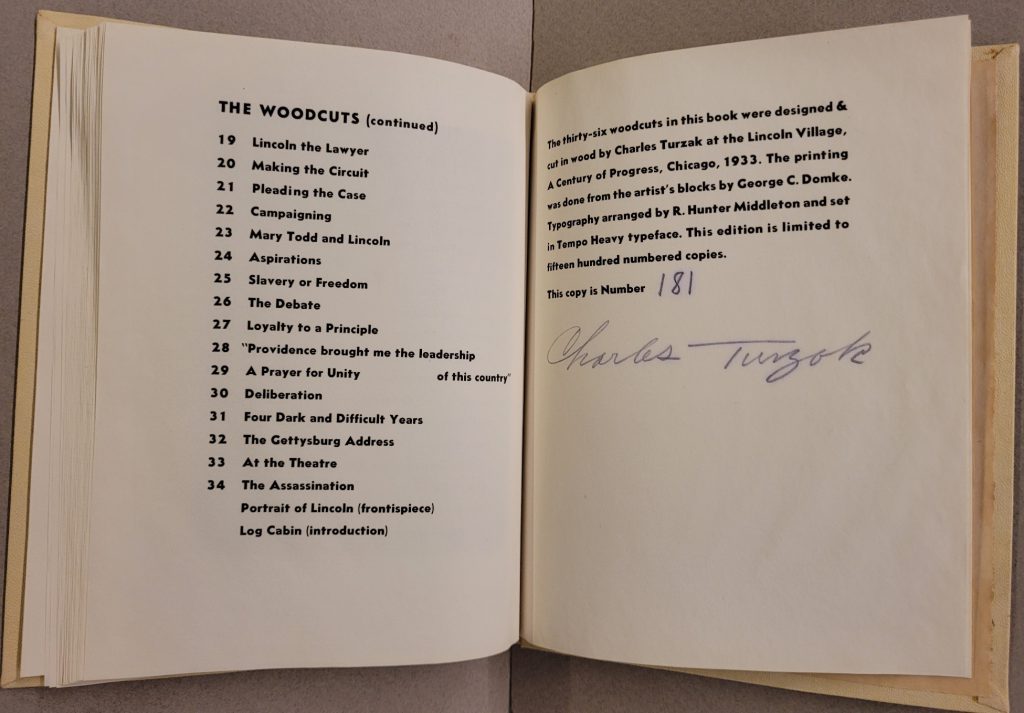
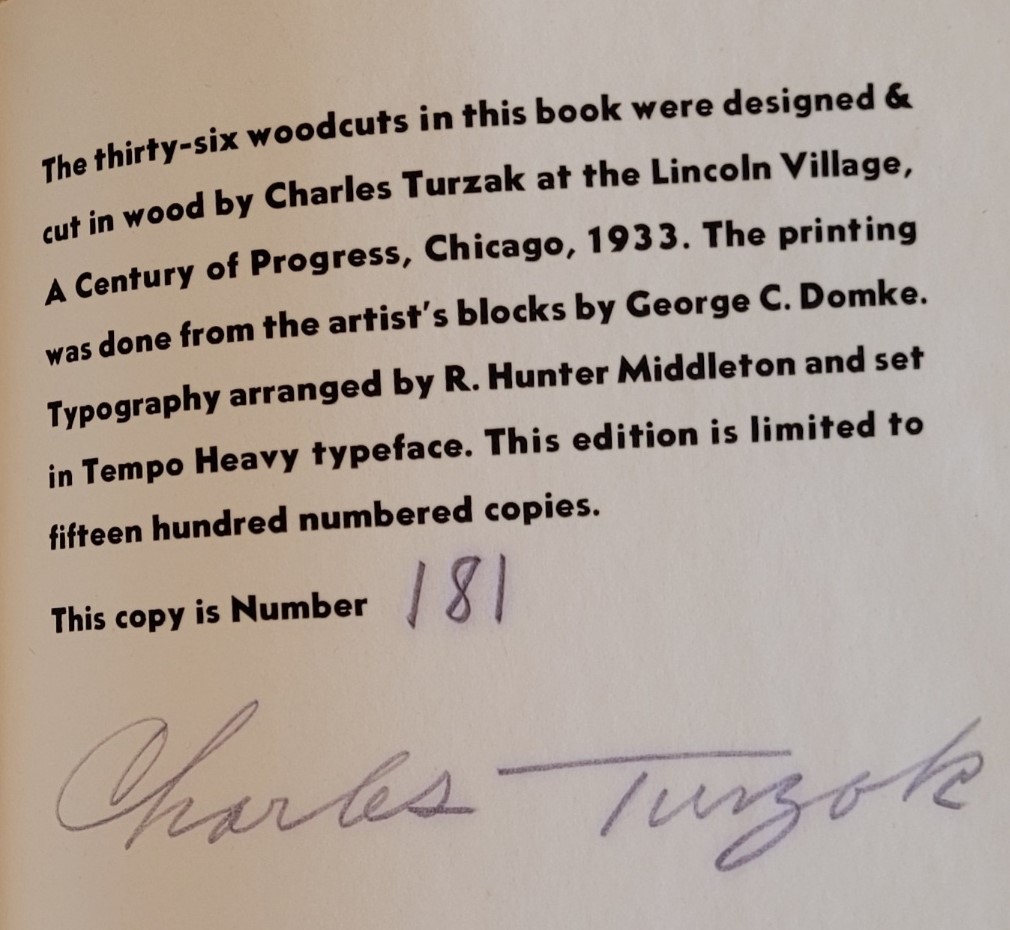
All copies are numbered, and nearly all are signed, but not all. The absence of a signature is not a defect, as the prospectus and limitation page only state that copies are to be numbered.
COMMENTS
If you disagree with something on this page, have an improvement, or have a comment please contact me
wn at wordlessnovels.com
Any information used will be given a credit line.