Zebrology – Satire and Subversion of Nazi Nuremberg Race Laws
It’s all about context.
Taken at face value, Zebrology (1937) and How the Flying Fishes Came Into Being (1938) by H. A. Rey are both charming but frivolous children’s cartoons in eight panels. This is reinforced by the publisher, Chatto & Windus, in its 1939 Autumn catalogue, describing Rey as a “juvenile artist and writer”. As a side note, many of his numerous children’s stories remain in print to this day.
At odds with this is the short description in the same Autumn catalogue, where the publisher referred to the two publications as “sophisticated, and mainly intended for the adult”.
To make sense of this, one must consider world events, particularly European ones, in the 1930s. Rey was a German Jew living in Brazil, and his wife-to-be, Margret, moved there in 1935 to escape the rise of Nazism in Germany. At the time, they both had family remaining in Germany.
Race Defilement
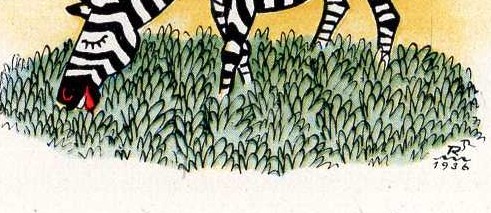
In September 1935, Germany passed the Nuremberg Race Laws prohibiting marriage and sexual relations between Jews and Non-Jews. This was later extended to Blacks and Roma, among others. Fundamental to the racial theories underpinning Nazi ideology was the Nazi commitment to prevent “race defilement”. Ray and Margarete married in 1935 and visited their family in Germany from April 1936 to February 1937. The last image in Zebrology is signed by Rey and dated 1936 – presumably drawn while he was visiting Germany.
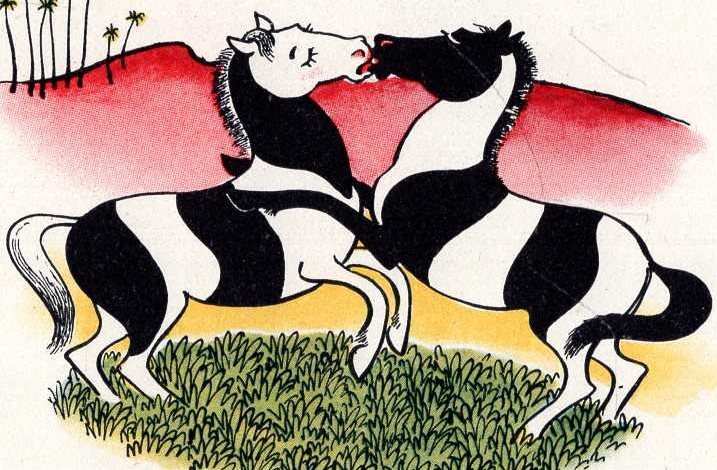
In this context, the satirical or subversive (and adult) nature of the stories is more easily appreciated. Zebrology starts with a White female horse being courted by a Black male horse. This leads to “degeneration” into half-Black and half-White creatures. Ultimately resulting in the disappearance of White or Black horses, leaving only black and white striped zebras – a miscegenation offensive to Nazi sensibilities.
Flying Fishes has the same theme and a slightly more explicit tone, with a panel showing a bird and a fish on very friendly terms; the following panel shows a discreet nighttime scene where neither is present, but the moon looks down and smiles. The next picture shows a nest full of flying fish-like half-bird creatures being fed by their parents.
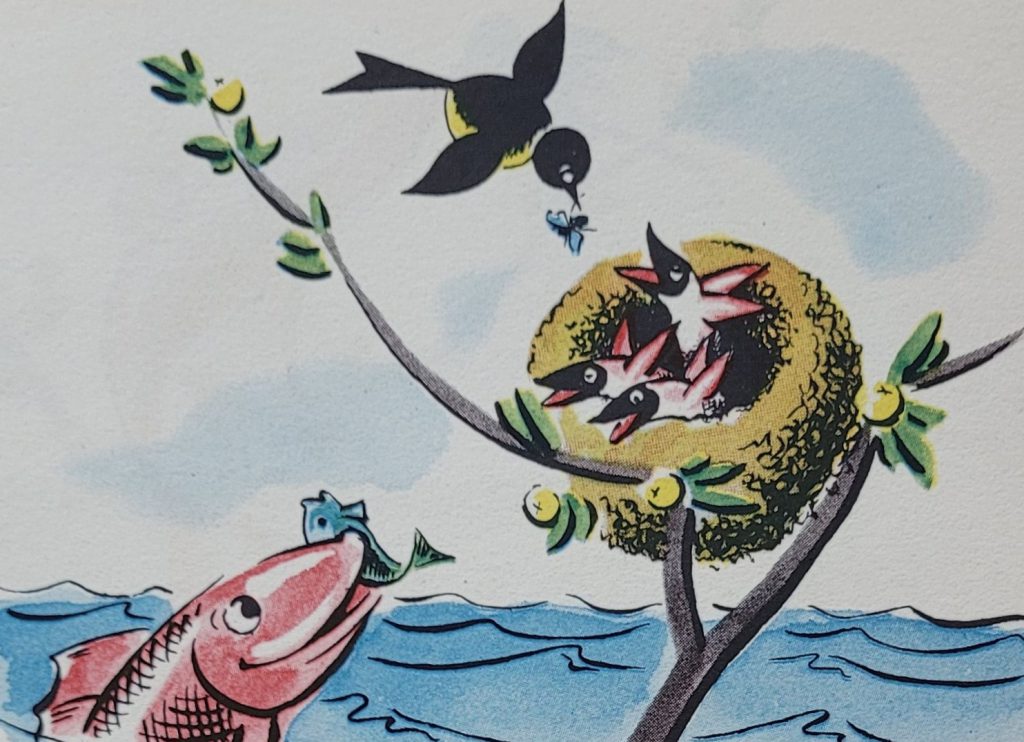
offspring and the other parent feeding them fish.
Racial Hierarchy
In addition to racial purity, Nazi ideology relied on a hierarchy with the Nordic race at the apex and inferior races (and even worse, animals) to be subservient.
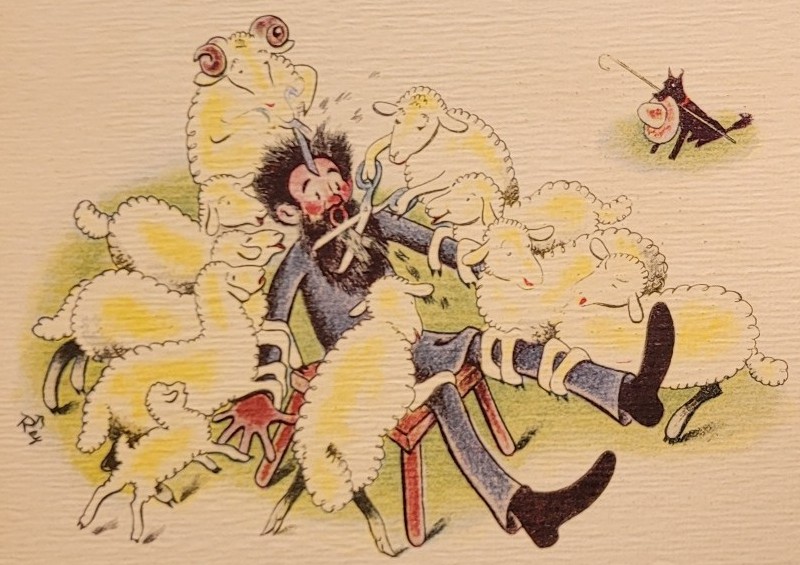
Rey had additional drawings featured in two other editions of The Courier Magazine in its Satire section under the title, The Beast Bites Back. Both issues consist of four panels that don’t have a story, just a common theme. The drawings embody a mockery of the hierarchy envisioned by the Nazis, as can be seen below. These Beasts clearly do not know their place.
As to the question: Satirist or Subversive? Perhaps the answer is that Rey is both a satirist and a subversive, earning Zebrology and Flying Fishes the publisher’s characterization as “sophisticated, and mainly intended for the adult”.
NOTE: I would like to acknowledge the insights contained in Yuliya Komska’s article, Why Curious George Did Not Speak: The Conspicuous Multilingualism of Margret and H.A. Rey; German Studies Review, Volume 41, Number 3, October 2018, pp. 505-528; Published by Johns Hopkins University Press.
COMMENTS
If you disagree with something on this page, have an improvement, or have a comment please contact me
wn at wordlessnovels.com
Any information used will be given a credit line.