Helena Bochořáková’s 1934 woodcut novel, Indiáni Jindy a Dnes (Indians Then and Now), is a “wordless” story that explores the trajectory of Indigenous North Americans. It arises out of her trip to North America – looking at indigenous groups historically and in the present.
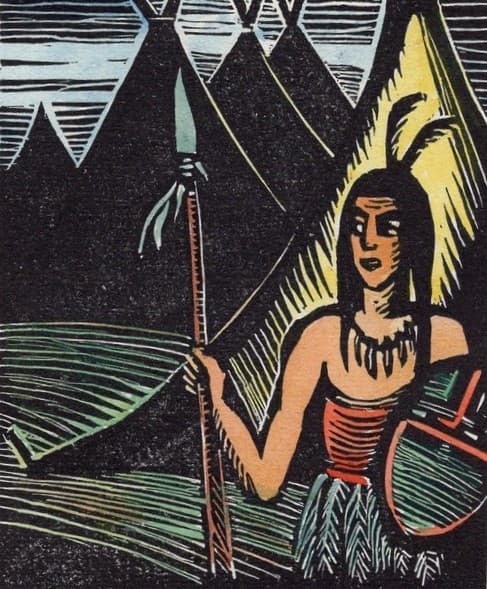
Indiáni Jindy a Dnes. All the prints were black and
white, but this is one of the few examples of hand-colouring.
Story Arc
The book is divided into two distinct themes:
- the “Then” (History and Resistance)
- with a focus on the Pontiac Rebellion depicting the Indigenous tribes of the Midwest and their military resistance against the British occupation.
- The woodcuts illustrate scenes of battle, the defense of ancestral lands, and the initial encroachment of European forces.
- the “Now” (Survival and Marginalization) with
- Life on the Reservation: The “Now” segments move away from warfare to focus on the daily life of the Pueblo and Navajo peoples. It highlights a community in transition.
- Environmental and Social Exploitation: The arc draws a direct parallel between the destruction of Indigenous culture and the exploitation of the land.
Perhaps her most magnificent contribution to the genre of the graphic novel, Indiani recounts the hardship experienced by the Native populations in North America following the arrival of the Europeans. The novel opens with images showing the seemingly idyllic (though difficult) lives of Native Americans before European contact, but quickly shifts to tell the story of the Ottawa chief Pontiac’s battle against British forces in 1763. The remainder of the work focuses on the lives of the Apache, Navajo, and Quechan tribes of the now Southwestern US, in modern-day Arizona…
Dealer – James Steerman
…..inspired by a trip to America in 1931 during which she visited Peche Island, the summer hunting grounds of Chief Pontiac, and Taos Pueblo, the oldest continuously inhabited indigenous American settlement. In the introduction, she describes “burning with anticipation to see my childhood dreams embodied here in this precinct of old romantic fables” and imagines observing the ghosts of Native American civilizations through the fog clouding the landscape. The resulting work illustrates scenes of domestic life, cultural customs, and warfare: “From this perch on Lake Erie arose my wordless book. Here the whole ancient life of the red tribes arose for me from its mists”.
Dealer – Peter Harrington
Publication Details
- Title: Indiáni Jindy a Dnes – Kniha dřevorytů (translated: Indians Then and Now – A Book of Woodcuts)
- Author and Illustrator: Helena Bochořáková-Dittrichová
- Introduction: Seven pages by Helena Bochořáková-Dittrichová in Czech
- Year: 1934
- Publisher: Josef Hladký
- Place of publication: Hranicích
- Printer: Knihtiskárna Pokorný a spol. (active during the 1920s and 1930s in Brno. Noted for its collaboration with avant-garde artists and its contribution to the golden era of Modern Czech book design).
- Copyright: artist?
- Dust jacket: No DJ to my knowledge; it probably come with a thin card shipping case.
- Binding: hard cover
- Language: Czech
- Paginated: unpaginated
- Printed: recto
- Edition: 25 Artist’s copies and 100 Publisher’s (Trade) copies.
- Description: The book describes the struggles of the American Indians in the Midwest and Southwest, beginning with Ottawa war chief Pontiac’s battles against the British military occupation in 1763, followed by descriptions of Arizona and New Mexico American Indians.
Indiáni Jindy a Dnes – 25 Author’s Copies
- Numbered in Roman numerals: I to XXV
- Size: 27 x 19.7 cm (10 5/8 x 7 3/4 inches)
- Signed?: Unlike other books by the artist that indicate some editions are signed, this book merely states that copies are numbered; i.e., a copy lacking a signature can not be assumed to be deficient. That said, all known copies have been signed on the FFEP.
- issued with a plain slipcase
- fore and bottom edges uncut
- red (sometimes orange- faded?) ribbon page marker bound in
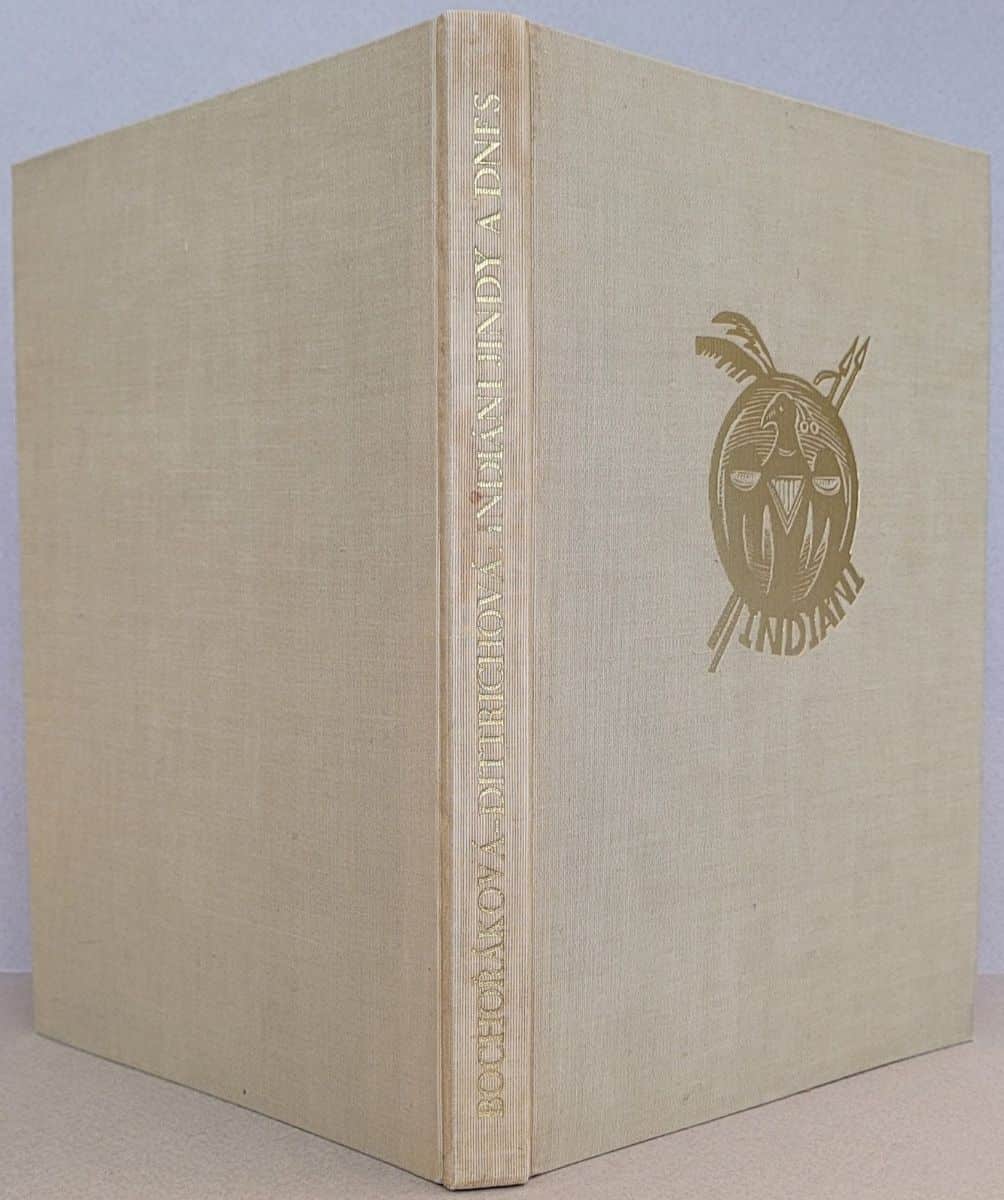
on the spine and a stylized shield on the front cover.
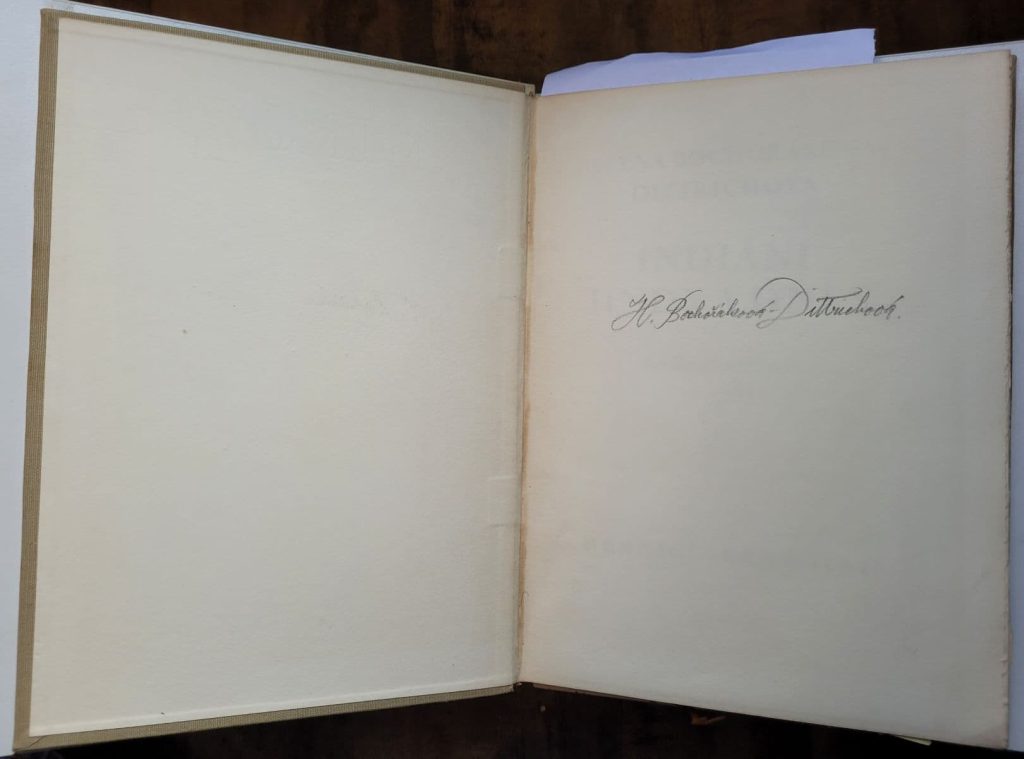
the FFEP of Indiáni Jindy a Dnes.
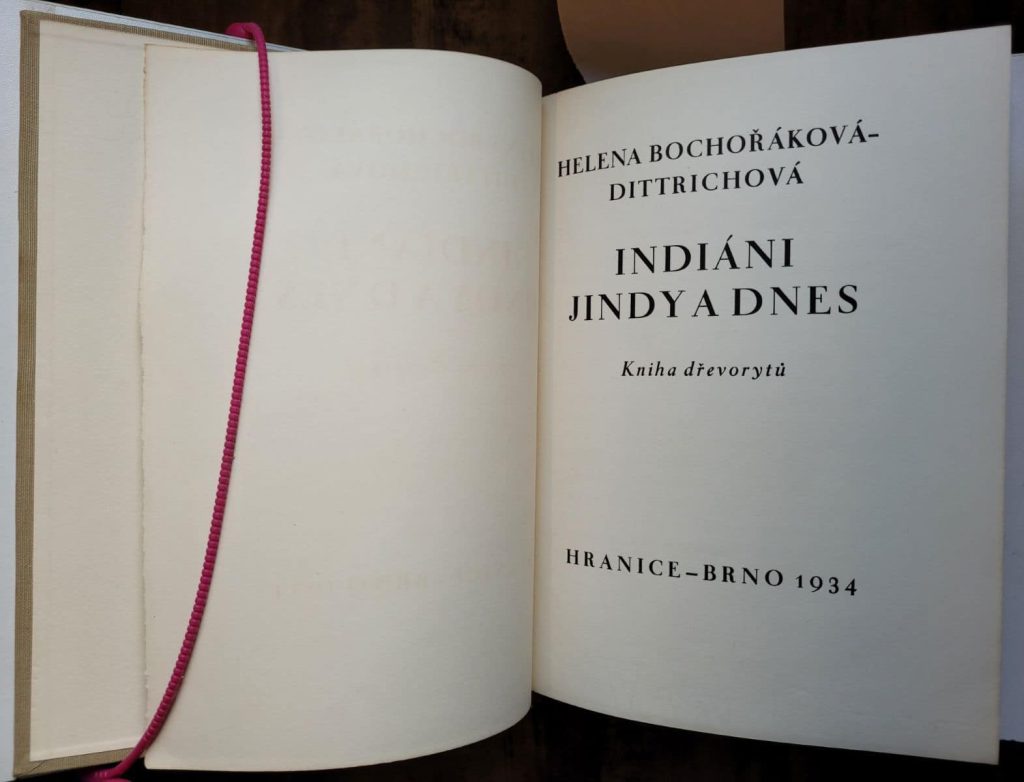
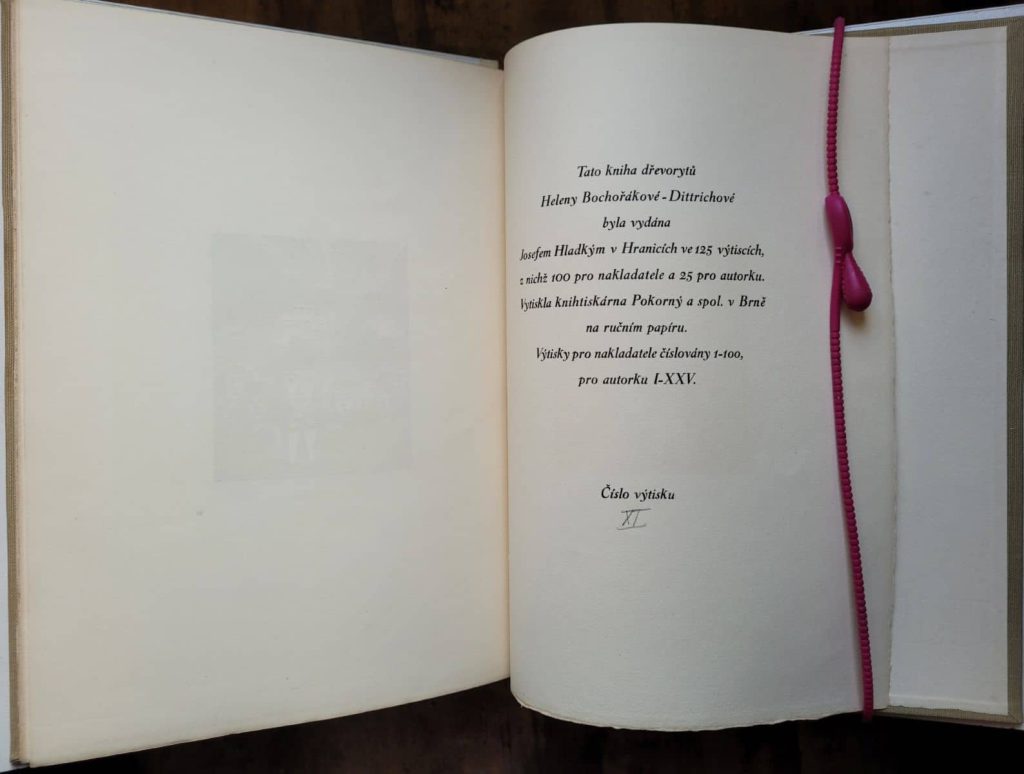
Jindy a Dne. This example is marked”XI” in pencil.
Translation of the Colophon
This book of woodcuts by
Helena Bochořáková – Dittrichová
was published
by Josef Hladký in Hranice in 125 copies, of
which 100 for the publisher and 25 for the author.
Printed by book printer Pokorný a spol, in Brno
on handmade paper.
Copies for the publisher numbered 1-100,
for the author I-XXV.
Indiáni Jindy a Dnes – 100 Publisher’s copies
- Numbered 1 to 100
- A copy without a number would be considered a deficiency
- Signed?: Unlike other books by the artist that indicate some editions are signed, this book merely states copies are numbered
- i.e., a copy lacking a signature cannot be assumed to be a deficiency. That said, all known copies have been signed on the FFEP.
There is no indication of differences between the author’s and the publisher’s copies (paper types?) – if you have any information, please advise. wn@wordlessnovels.com
Hand coloured?
Hand coloured? – some plates, in some books, are hand coloured. Anyone with information about this, please contact me – wn@wordlessnovels.com
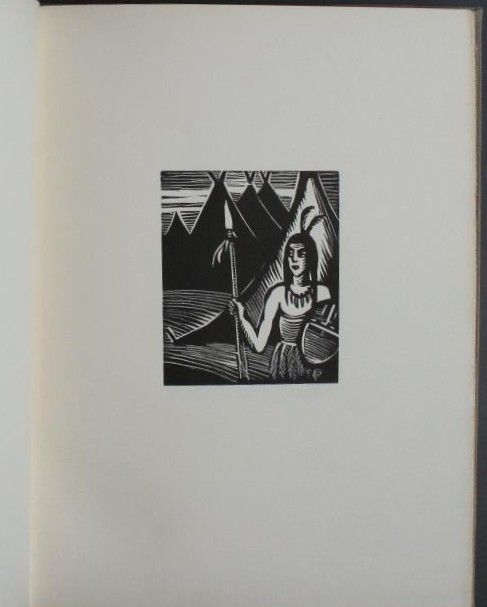
showing Plate 2 without hand colouring.
Indiáni Jindy a Dnes. All the prints were black and
white but this is one of the few examples of hand-colouring.
COMMENTS
If you disagree with something on this page, have an improvement, or have any other comment please email
wn at wordlessnovels.com
We will give you credit for any information used.