Totentanz, but the Maiden defeats Death
In Budzinski’s wordless story, Totentanz, the Grim Reaper attempts to seduce the Maiden, only to find the tables turned.
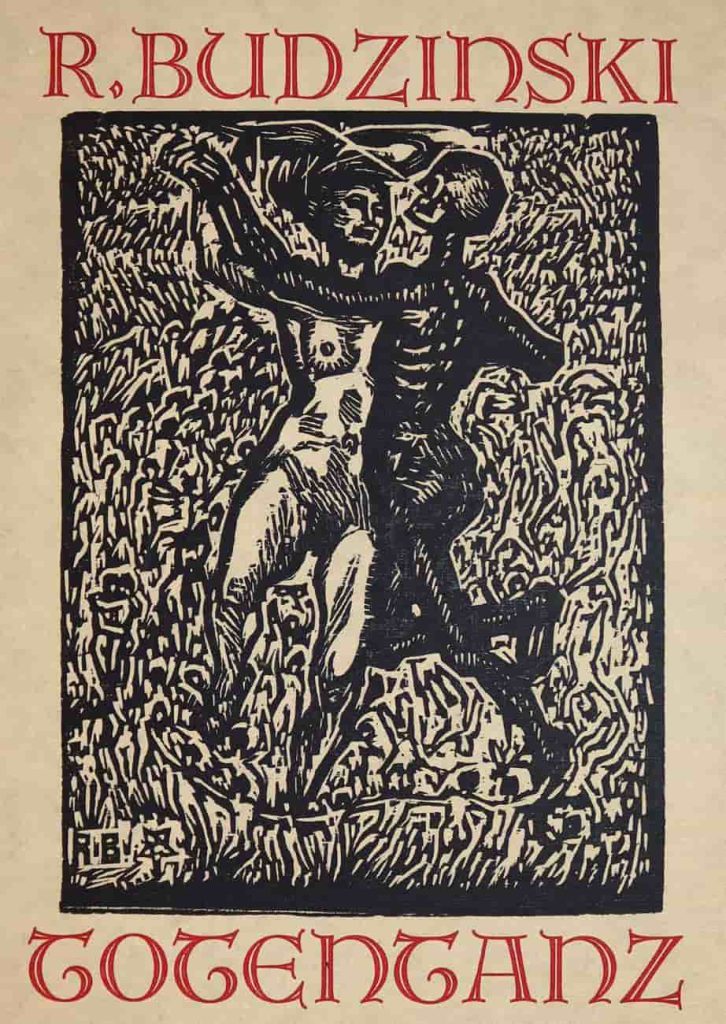
Robert Budzinski’s wordless story from
1924, showing the Maiden dancing
with the Grim Reaper.
The image on the folder cover is printed from a woodcut. The 1948 version did not use this image.
Barthel’s 1924 Introduction
The 1920s were a time of great social upheaval worldwide. In this 1924 introduction, Barthel points out that while Death takes the rich and the poor alike, the poor die younger, yet he sees hope in recent social changes and believes that the future belongs to the young, rising class as symbolized by the Maiden defeating Death.
Bibliographic information for Budzinski’s, Totentanz
Totentanz consists of a folder featuring the image above, an introduction, and 8 sheets that tell the story. The publication provides no information as to the printing date, place of publication, etc. WorldCat provided the publication information.
- Title: Totentanz
- Author: Robert Budzinski
- Illustrator: Robert Budzinski
- Introduction: Max Barthel
- Date of publication: 1924 (Note: the year 1924 is based on worldcat.org entry details. Other sources have advanced 1918 and c. 1920s)
- Publisher: Verlag Die Wölfe (Note: the name of the publisher is based on the worldcat.org entry details)
- Place of publication: Leipzig
- Printer:?
- Copyright: Artist?
- Dimensions:
- Folder: 34 x 25 cm (13 1/4″ x 9 13/16″)
- Image size on the front of the folder: 18 x 13.2 cm (slightly larger than the images on the 8 sheets)
- Sheets: 32.7 x 23.2 cm (12 7/8″ x 9 1/8″); thin stiff card
- images on the sheets: 17.5 x 12cm (roughly all are the same size)
- Folder: 34 x 25 cm (13 1/4″ x 9 13/16″)
- Binding: 8 sheets plus the introduction are loose in the folder
- Language: German titles, etc
- Paginated: sheets are numbered
- Printed:
- Introduction is on a single sheet, printed both sides.
- Sheets with images are printed on one side only.
- Printed from the original matrix: there is no information accompanying the folder or the sheets regarding the printing process, but examination of the back sides of the images suggests they were printed in relief, consistent with printing from the original wood blocks.
Images for Budzinski’s 1924 Totentanz
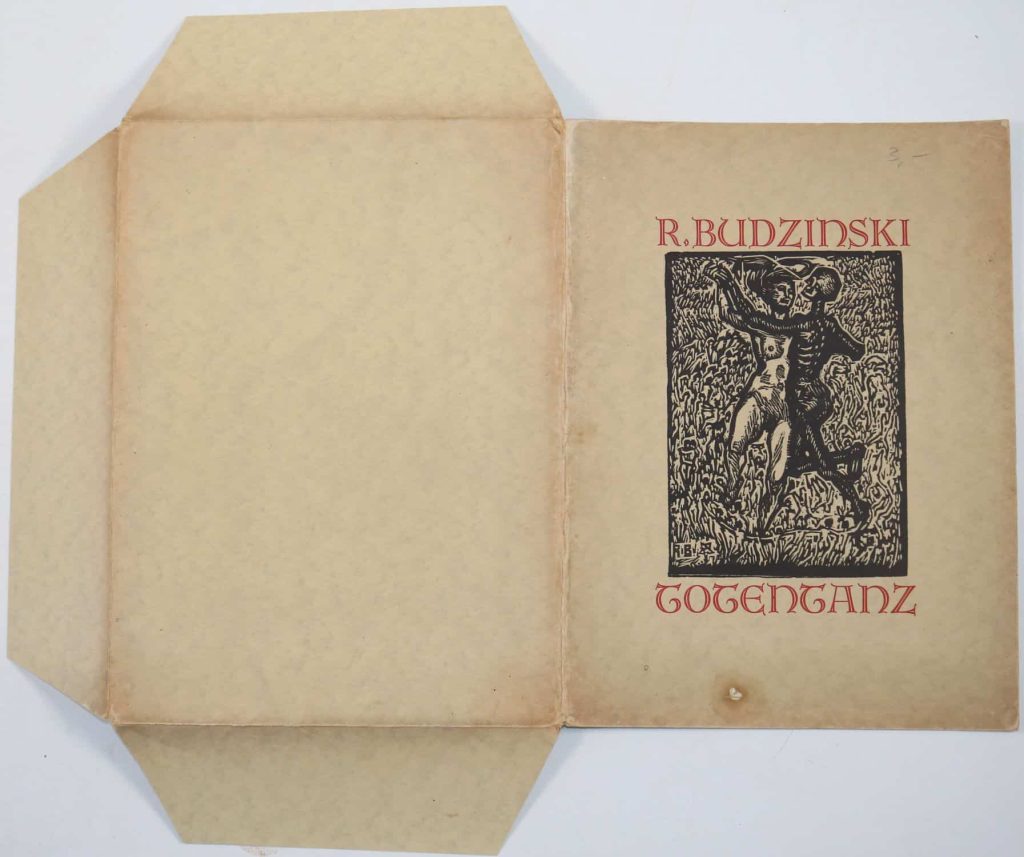
story, Totentanz, showing the Maiden dancing with Death
surrounded by miniature figures.
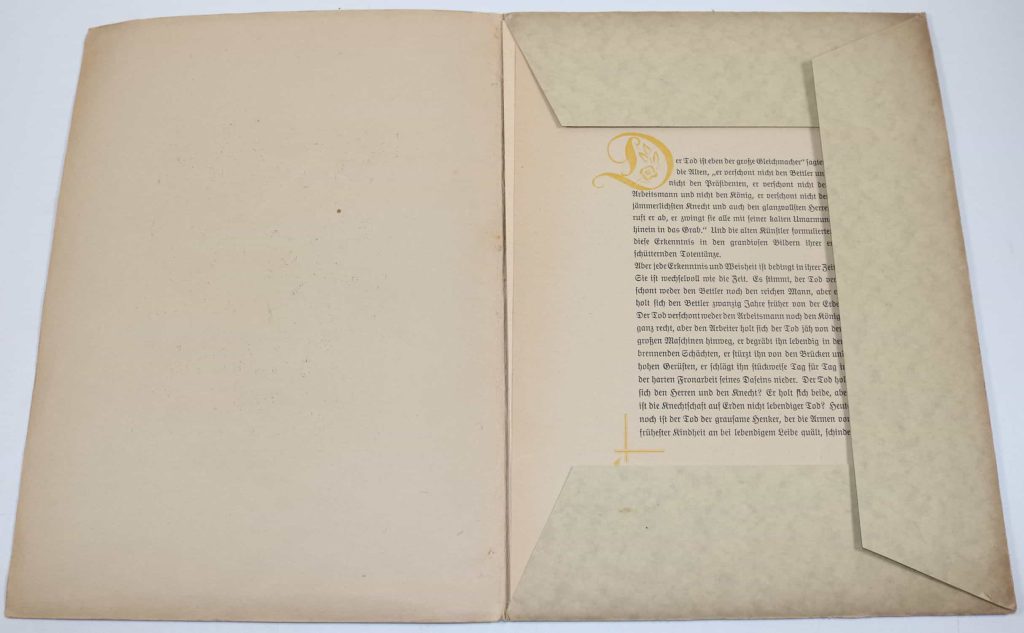
showing the 1st page of the introduction.
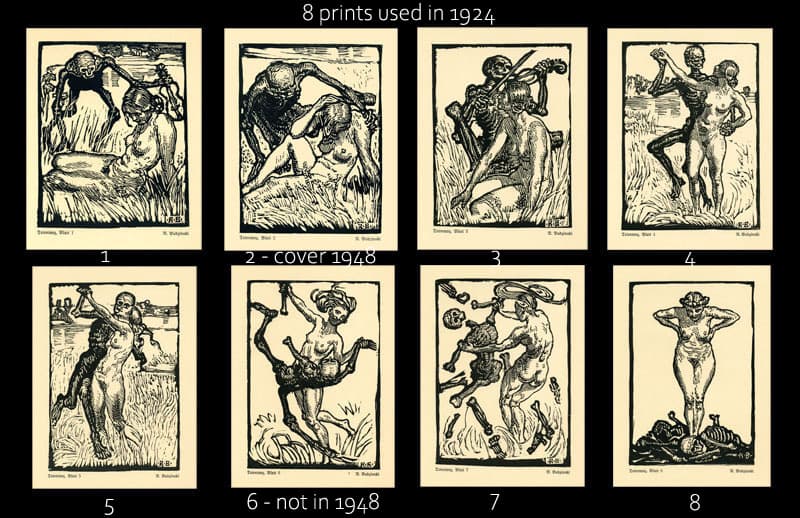
1924 wordless story, Totentanz.
These 8 images tell the story of Death approaching the Maiden, attempting to seduce her with music and dance, but ultimately the Maiden vanquishes Death, at least for the time being.
Image #2 was later used for the cover of the 1948 version and #6 was not used at all in the 1948 version.
All 8 sheets are initialled in the lower right of the image. Each sheet has printed below the image lower right “R. Budzinski”; lower left is printed “Totentanz, Blatt” (German for “sheet”) and then the sheet number.
There is a suggestion Budzinski’s mistress and muse, Erika Stern, had been seriously ill but made a recovery and this series was based on that. Any information in this regard would be appreciated.
1948 rewrite: Der Sieg des Lebens (Auch ein Totentanz)
In 1948, Budzinski streamlined the story for clarity and dropped one image (perhaps because the Maiden’s face was poorly drawn). He added a new introduction and retitled the work to emphasize the Maiden defeating Death. You can see the 1948 version here.
COMMENTS
If you disagree with something on this page, have an improvement, or have any other comment please email
wn at wordlessnovels.com
We will give you credit for any information used.